From Consultation to Decision: What Public Input Can and Cannot Do
Consultation to decision: learn what public input can change, how it differs from a vote, and how to identify the open choice and promised response.
What can your response to a public consultation actually change? Consultation to decision is not a ballot: it is a way to put views and relevant information before the people authorised to choose. Your first task is to find out which part of that choice is still open.
A council asking about a bus route might be seeking views on stop locations while treating the route’s purpose as settled. A department might invite comments while it is still choosing between several rules. Both processes are called consultations, but they offer different kinds of influence. Read the invitation for the decision it names, not just the questions in its survey.
Consultation’s purpose
Public consultation gives people, organisations and affected communities a way to provide information or express views to a public body. Responses can alert officials to overlooked consequences, competing priorities or practical knowledge. They also create a record of the reasons people support or oppose an option.
That does not make a consultation a vote. It is usually advisory: an authorised person or body makes the final decision, weighing responses alongside relevant evidence, legal duties, practical limits and interests that may not be represented in the submissions.
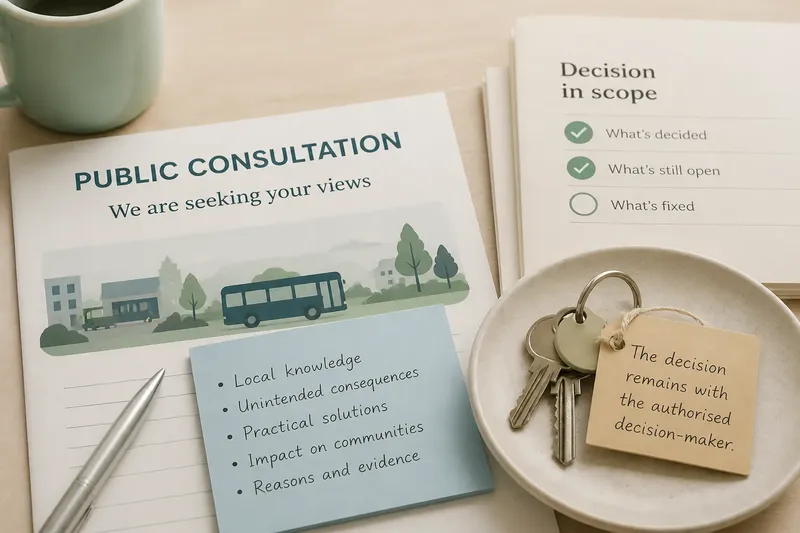
Think of consultation as a note placed beside a set of keys. The note can point out a problem with the route ahead, but it does not transfer the keys or decide who may use them.
Consultation and voting
A vote records a choice under specified rules. Depending on the ballot, voters might select a candidate, approve a proposal or rank options, and the result may have a defined legal or political effect. A consultation often asks for reasons, evidence or suggestions as well as preferences.
A survey that asks respondents to choose between options does not become a binding vote just because it has boxes to tick. Check the stated purpose and authority. Phrases such as “we are seeking views”, “the decision will be made by” and “the result will determine” signal different commitments; the consultation rules or legal basis may clarify them.
The number of responses does not automatically show what the wider public thinks. People decide whether to reply, and an invitation may reach some groups more effectively than others. A high volume can indicate strong engagement or a shared concern, but it is not necessarily a representative measure of opinion. Officials may consider the content and source of responses as well as the total received.
Find the open decision
Read the consultation document, not only its announcement or online survey. Look for the scope, options and next steps. The important boundary is what has already been settled and what remains for the decision-maker to choose.
- Decision-maker: Check whether the document names elected representatives, a minister, a regulator, a council officer or another body. If it does, direct your reasoning to the choice that body can make; if it does not, ask the organiser who has authority.
- Live question: Check whether the authority is deciding whether to act, choosing between options or refining an approved proposal. If the question is open, compare the options; if only details remain open, focus on those details.
- Fixed limits: Check for legal requirements, funding constraints, prior decisions or matters excluded from consultation. If a limit is binding, suggest changes within it; if the document does not explain its status, ask whether it is fixed or still under consideration.
- Response route: Check who will review submissions and how they will be considered. If a reviewer or method is named, tailor your response to that process; if neither is clear, ask the organising body how comments will reach the decision-maker.
- Published outcome: Check whether the authority promises a report, reasons or an account of changes. If it does, use that document to follow the decision; if it does not, ask where and when the outcome will be published.
- Response deadline and format: Check the closing date and any word limit or submission channel. If your response fits the stated route, submit it there; if you cannot use that route, contact the organiser to ask about an accessible alternative.
These checks show what kind of response is relevant. If officials are comparing designs, explain the differences in their effects. If the broad policy is settled, focus on implementation details that remain open rather than arguing as though the entire decision is still pending.
What input can change
A response can contribute local knowledge, expose an unintended consequence, challenge an assumption or explain why an option burdens a particular group. It can also support a proposal and clarify which benefits matter to people affected by the decision.
Influence depends on the scope of the decision, the relevance of the information and the decision-maker’s duties and constraints. A persuasive submission cannot remove a legal requirement or give a public body powers it does not have. Officials may also judge that other considerations carry more weight. Their reasons can show how they reached that judgement.
Say a town invites comments on changing library opening hours. Imagine you attend an evening class nearby, and the proposed closing time conflicts with its end. You submit that timetable conflict and suggest keeping one later opening each week. The town might reconsider the schedule or explain why another arrangement better fits its constraints. Your response gives officials a specific issue to assess; it does not cast the deciding vote.
Read the response promise
Some consultation documents promise a summary of themes and reasons for the final choice. Others say only that responses will be “taken into account”. That phrase signals consideration, not a commitment to adopt suggestions. Look for details about how the authority will show what it considered.
Useful signs include a named decision-maker, a timetable for the next stage, a description of how submissions will be reviewed and a promise to publish the outcome. The document may also say whether individual replies will receive answers, submissions will be public or similar comments will be grouped. These details tell you what to expect from the process, not whether your preferred option will win.
If the process is unclear, ask the organising body a narrow question about what remains open, who will decide or how it will report back. Refer to the specific consultation so the answer can clarify procedure rather than turn into a general debate about the proposal.
Questions about consultation?
Can officials reject consultation responses?
They may reject suggestions, but they should follow the process and duties that apply to the decision. Check the consultation’s stated commitments and the public body’s guidance; if a legal right or formal duty is at issue, seek advice from a qualified professional.
Does the most common view win?
Not automatically. A consultation gathers and weighs views, while a vote records a choice under specified rules. The authority should explain how it considered submissions within the decision it was empowered to make.
Can I respond for other people?
You can describe an organisation’s or community’s position if you are authorised to do so, and say whose views you are conveying. If you share an individual experience, explain what happened without implying that one account represents everyone.
What if the final decision changes?
Read the published decision and any response report to see what changed and why. A different proposal does not by itself show that consultation caused the change, just as an unchanged proposal does not show that responses went unread.
Follow the outcome
When the decision appears, compare it with the original scope and the response promise. Does the report explain the issues raised, what the decision-maker did with them and why it chose that option? Look for reasons, not just a tally of preferences.
Imagine a consultation on a neighbourhood street layout. The document says the council is choosing between a one-way arrangement and keeping two-way traffic, while parking rules are outside the scope. You favour the two-way option because a nearby care service needs access from both directions, and you describe that access issue in your submission. When the council publishes its decision, you check whether it chose an option, addressed access and explained its reasons. If it selected the one-way plan without discussing the issue, you can ask how that concern was considered; if it explains the trade-off, you can see how your submission fitted the decision even if the outcome differs from your preference.
The invitation, response, decision and published reasons form a document trail. Use it to judge whether the public input had the role the authority promised. For consultation to decision, the most useful question is not whether your preferred answer won, but whether the choice that remained open was considered on the terms the process set out.